
LITTLE PIM BLOG
Infographic: Second languages around the world
Here in the United States, it's well-known that the most commonly spoken second language is Spanish. But what about in other countries? Depends on where you go. In Africa, for example, there are a mix of tribal languages spoken in certain areas, while French, Italian and English dominate in others.
The Middle East also features a varied set of second languages, including Cantonese, Turkic, and Tagalog.
Overall, English is the most popular second language, with 55% of the world speaking English as their second language, followed by French (14%), Russian (13%) and Spanish (8%).
Even in primarily English-speaking countries, children are encouraged to learn another language at a young age, due to the cognitive benefits of learning languages and the globalization of our economy. Given that language acquisition is easiest when kids are young, starting early is key.
Check out the infographic below from Movehub to learn more about second languages in other countries, and check out our foreign language programs to start your child on the path to learning a second, third or even fourth language.

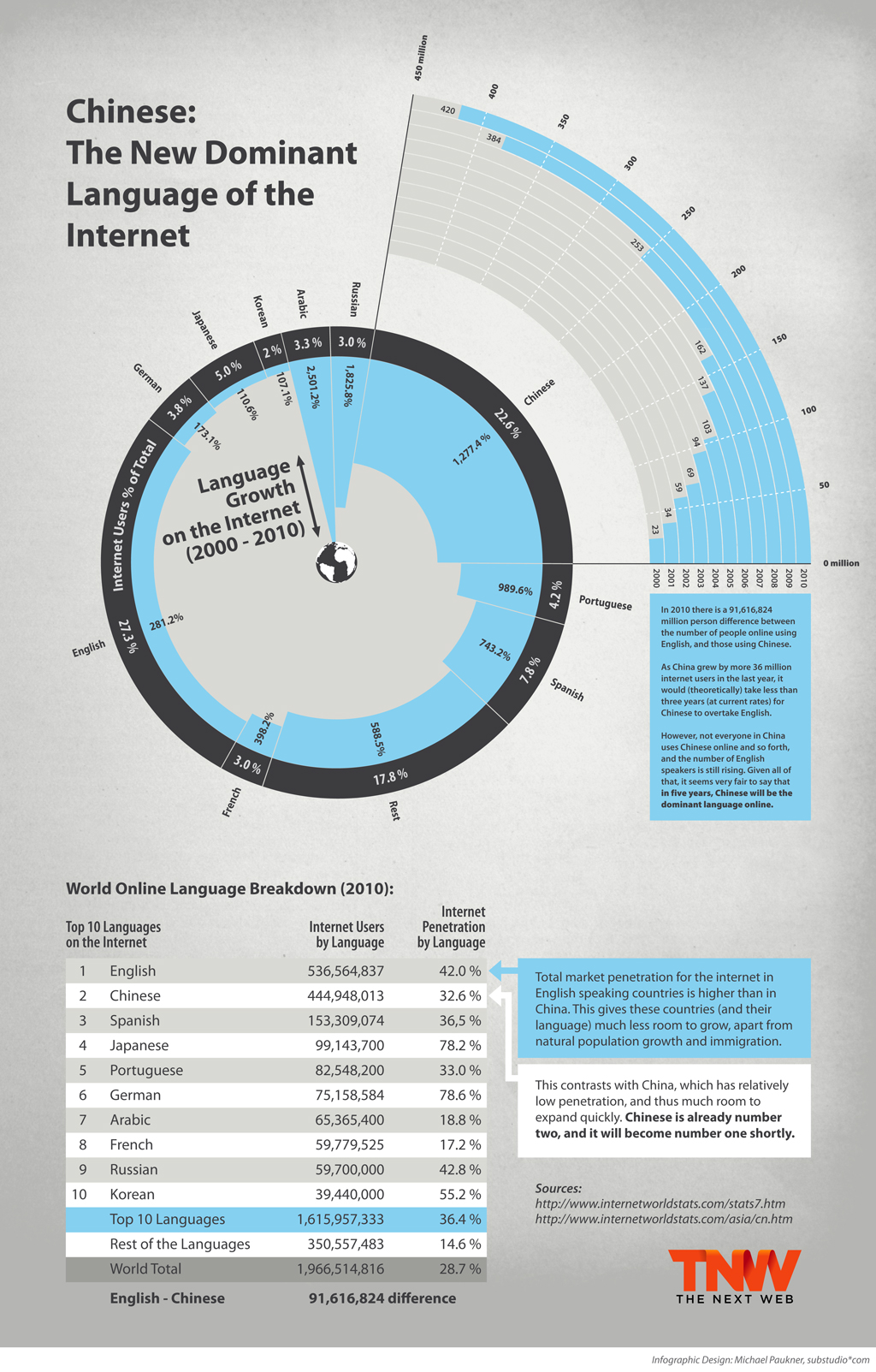
Chinese: The New Dominant Language of the Internet
Did you know that Chinese is on track to become the most-used language on the internet? According to Internet World Stats, there were 649,375,491 Chinese-speaking internet users in December 2013, making it second to only English, the most frequently-used language on the internet.
But experts predict English's dominance won't last long. Based on its fast pace of growth, within the next few years Chinese is expected to overtake English as the top language of the internet.
Check out the infographic below from The Next Web that shows the fast pace of Chinese language use on the internet, as well as the statistics for the top 10 languages of the world.
Want your child to start learning the soon-to-be dominant language of the internet? Check out our Chinese language learning program for kids.
And guess what? Each of the top 10 languages on the internet is available on Little Pim (or will be soon in the case of Korean).
With other languages starting to outpace English, it's important to prepare for the future. They can start learning today with our award-winning program.
International Halloween Traditions For Kids
Most people associate Halloween with the United States, but did you know that it actually began as a Celtic holiday and is still celebrated throughout the world? According to the National Endowment for the Humanities, the day was originally called Samhain, or "Summer's End," and marked the end of the harvest season for Celtic farmers. October 31st was considered a day when the normally strict boundaries between the worlds of the living and the dead were blurred, and the ghosts of those who had passed away came back to earth.
The traditions of costumes, parades, and playing scary pranks and tricks are rooted in ancient practices as well. By wearing masks and costumes, people would try to fool the spirits into believing they were also ghosts, so the spirits would leave them alone on Halloween night.
But celebrations of the dead aren't limited to the ancient Celts and modern Americans. According to Education Magazine, countries all over the world hold their own similar festivals to honor the dead.
Mexico: Perhaps the most famous outside of the American holiday, Mexicans celebrate Dia de los Muertos, or Day of the Dead, on November 1st and 2nd. It's a time for family and friends to remember departed loved ones. Day of the Dead bread, or "Pan de Muerto," is a quintessential dish made during Dia de los Muertos. Learn to make you own here.
Great Britain: The British celebrate by partying in costumes from October 31st to November 5th, Guy Fawkes Night. On this night, the Brits commemorate the infamous British traitor Guy Fawkes by lighting bonfires.
Ireland: Honoring its Celtic heritage, Halloween is still celebrated today in Ireland. Barmbrack, a sweet fruit bread, is traditionally served on Halloween night. Check out a great recipe here.
China: The Chinese festival of Teng Chieh is a Lantern Festival that closes off Chinese New Year celebrations. Lanterns formed like dragons, swans, and other animals are hung in the streets or near households, protecting people from evil and lighting the way for wandering spirits. Check out this easy craft so your little one can make his or her own lantern for Halloween.
Japan: In Japan, the Obon Festival is celebrated in the summer to honor the spirits of the dead. During the festival, is lit each night to guide a spirit to its family’s location so that the dead can return to where they were born.
Halloween is a great time to introduce your child to some of the other cultural festivities celebrated by children around the world. Introduce some of these global traditions to your kids, and check out our Halloween board on Pinterest for fun crafts, recipes and cultural activities you can share with your little ones this Halloween.
photo credit: Ariel Ophelia via photopincc
Celebrate National Hispanic Heritage Month with Little Pim
Did you know that September 15 to October 15 is National Hispanic Heritage Month? Every year, Hispanic Americans celebrate the contributions of American citizens whose ancestors came from Spain, Mexico, the Caribbean and Central and South America. September 15 marks the beginning of the month because it is the anniversary of the day Costa Rica, El Salvador, Guatemala, Honduras and Nicaragua celebrated their independence. Mexico, Chile and Belize also celebrate their independence days on September 16, September 18, and September 21, respectively.
The month culminates with a celebration on October 12, when Spain and Latin American countries celebrate their own version of Columbus Day, known as Hispanic Day (Día de la Hispanidad) to commemorate Christopher Columbus's voyage to the Americas on behalf of Spain in 1492. This is considered the National Day of Spain (Fiesta Nacional de España), and parades and festivals are held throughout the country.
Young kids may be familiar with the story of Christopher Columbus's voyage to the Americas for Spain, but as a Columbus Day nears, it's a great time to teach them there's more to the story than just the Niña, the Pinta and Santa María.
Your kids (or students) will love this interactive white board activity from Scholastic that features fun Hispanic facts, history and even a Piñata concetration game.
We also love this set of printables of famous Hispanic American role models from Nick Jr. And this Hispanic paper flower fiesta craft from Latinaish will have your house (or classroom) looking festive in no time.
Of course, it's also a great time to introduce kids to Spanish language and culture. Check out our Spanish Bop CD featuring fun 15 Spanish language songs for kids, our Spanish vocabulary flashcards, or our colorful English-Spanish books perfectly suited for young kids.
Make a Rainbow Loom Little Pim Panda
If you have young kids (especially daughters), chances are you've heard of Rainbow Loom. Rainbow Loom makes it easy for young kids to make bracelets, charms, and other toys out of rubber bands using looms and hooks. It's a fun, unique toy that gives kids the freedom to indulge their own creativity--and it's actually been shown to have positive effects on their development.
We're such big fans of the toy that we wanted to share our love by making a Rainbow Loom craft of Little Pim the panda, the star of our award-winning videos, books and flashcards.
If your kids love Little Pim and making crafts with their looms, they'll love making their very own panda.
Watch the video below from Dana Loomz to find out how, and be sure to send us your kids' finished products or post them on our Facebook page--we'd love to see them! [youtube id="lpkKn6Glp-0"]
Stanford researchers say early language learning is critical
How do we begin to learn a language? How do young children go from the "goo" (baby talk) to being able to form real words and sentences by the time they're toddlers? In the video below, Stanford researchers discuss their studies involving children's language learning, what abilities are involved in language learning, and how language interacts with kids' understanding of their social world.
[youtube id="TBiE5F83ZE4"]
The researchers explain the importance of understanding how kids learn so that we can begin to design better early childhood intervention programs for kids who aren't getting enough language input, or in cases of developmental disabilities.
They also stress that the language children are exposed to in infancy and early childhood has a huge impact on their later language and academic abilities. As Associate Professor Michael Frank says in the video,
The language exposure you get early on in life is really critical for your later language proficiency and your school performance.
Their conclusion backs up the premise behind our award-winning language learning program: the best time for kids to learn a language is before age 6. Be sure to check out the research behind our method to learn more about how we integrate scientific studies like these to help kids effectively learn languages, both native and foreign.
5 Back-To-School Stress-Relief Tips for Busy Parents
Back-to-school can be a stressful time for parents. Between homework, routine changes and the difficulty of parting with your child for the day, it's not easy dealing with the back-to-school bustle. In honor of busy parents facing the new school year, we've put together some stress-relief tips and tricks to help calm you down and get your school year off to the right start.
1. Prepare the night before.

Planning ahead is the best way to avoid the morning time crunch. Packing your child a lunch or snack the night before can save some early-morning headaches. Lay out the cereals, muffins or anything else you need to make breakfast the night before so it's ready to grab and go. Help your child pick out his or her outfit in advance so there's nothing to worry about in the morning.
2. Get a massage.
Don't think of a massage as an indulgence--think of it as something that'll help you manage your stress so you'll have more time, energy and smiles for your little ones. You can also do self-massage--or perhaps persuade your little one to give you a nice foot rub in exchange for a treat.
3. Do stress-relief exercises and stretches.

Modern parents are particularly susceptible to shoulder and neck pain because so many of us work in front of a computer for most of the day. In addition, breastfeeding, stress, sports, and carrying a heavy baby bag or purse can also contribute to pain in this area. Check out some of these great tips from Stress Free Mama, or try some of these stress-busting yoga poses perfect for busy parents, even if you have no yoga experience.
4. Have some fun with the kids.
You can still relieve your stress even while hanging out with the kids. Dance to some fun multicultural beats, cook up a global-inspired meal or sit down together and read one one of these famous children's books from around the world.
5. Don't try to be SuperMom or SuperDad. No parent is perfect. We're all going to mess up, be late or forget to do something for our children on occasion. Learn to forgive yourself for your mistakes and use the experience to figure out how you can be better next time.
photo credit: Nikki McLeod via photopincc and billhd via photopincc
Little Pim Supports Universal Pre-K
All children deserve a smart start in life. National and local momentum has built behind universal pre-K, an international movement to make quality preschool education accessible to all children in the United States. Several states including Georgia, Oklahoma and Florida already offer pre-K to all children, and 40 states, overall, offer at least some publicly funded pre-K programming. Here in New York City, where Little Pim is based, a recent state budget agreement has enabled the mayor, Bill de Blasio, to begin working to add 53,000 new full-day pre-K seats to the city's public school system. President Obama and Washington lawmakers from both sides of the aisle are pushing for Congress to approve federal support and we can hope to see more states follow suit in the upcoming years.
Progress is underway, but the United States must continue to expand access to ensure its children remain competitive in the global marketplace. Many other industrialized countries, including France, Sweden, Canada, India and Australia have long offered government-funded public preschool programs – and it's easy to see why.
Research indicates that high-quality early childhood education offers enduring benefits – benefits similar to those brought by early bilingualism. It has been found to improve children's long-term cognitive abilities, boosting language, literacy and mathematics skills, and to positively affect behavioral traits including sociability, motivation and self-esteem.
What's more, studies show, the benefits of pre-K for kids continue into adulthood, leading to greater college success, higher incomes and lower rates of incarceration. These benefits are most pronounced for disadvantaged kids but there are undeniable benefits to early education for children from all socio-economic backgrounds.
The growing support for expanding access to pre-K is exciting – and the result of parents and lawmakers taking action to level the playing field for kids and provide each and every one of them with the tools they need to succeed in school and beyond. We applaud their efforts and are in lock step with this important movement.
At Little Pim, the idea of democratizing education has always been one of our most important guiding principles. We believe strongly that all young children should have the opportunity to learn a second language when they can learn it best – in that critical window, from birth to age 6. These children will be better positioned to achieve success in an increasingly global world. In the wake of the Universal PreK movement, we would love to see a greater national focus on early world language education for all children.
10 Great Kids Books With Global Appeal
 Sail away with your kids to magical lands across the sea – just by picking up a book. These 10 great kids books will give your family a glimpse of cultures and a taste of languages around the world. You can read all of them in English, but if you’re feeling up to it, several (such as the French classic The Little Prince) can easily be found in their original language. Whatever you choose, reading with your kids is a great way to bond and let their imaginations grow. Plus, it’s one step closer to getting ready for school, which will be here before you know it.
Europe
1. The Adventures of TinTin (Belgium) – A dog and his intrepid young reporter owner solve mysteries around the world – the comic strip imagery is especially popular with young children; and the comics are also available in French.
2. The Little Prince – A lovely French classic that tells the story of an aviator who meets a prince from a distant asteroid while stranded in the desert. This is a good one to try in French if you can.
3. The Invention of Hugo Cabret – Take a trip through Paris with the vivid pencil images in this imaginative story of Hugo, a boy who lives in a train station in Paris, and the friend who helps uncover his mechanical secret.
4. Strega Nona—Although written in English, this is the tale of an Italian “Grandma Witch” who lives in Calabria and makes enough pasta to bury an entire town. There are more than a dozen Strega Nona stories to keep the pasta-fueled fun going.
Scandinavia
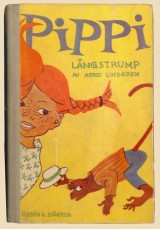 5. Pippi Longstocking –Sweden’s contribution to global kids’ imaginations is this firecracker of a main character, a red-headed 9-yr-old with a with a suitcase full of gold, a pet monkey, and horse on her front porch. A great read out loud book that will make you and your kids laugh out loud.
6. The Moomins – A Swedish/Finnish illustrated collection of books about a family of animal-like creatures. The pictures are sure to captivate kids, and if they really love it, there’s even a Moomin theme park in Finland!
Asia
 7. Lon Po Po – A Red Riding Hood Story from China – In this Chinese reworking of the classic Grimm fairytale, three sisters in rural China outwit the (heads up, relatively scary looking) Lon Po Po (Granny Wolf). Great for kids who like their stories to keep them on the edge of their seat.
8. The REAL Story of Stone Soup – Another children’s classic story with a Chinese twist. This time three clever brothers turn stones into egg drop soup – keep an eye out for Chinese vocabulary sprinkled throughout the story.
Africa
 9. Anansi The Spider – From West Africa comes this Ashanti fable of a small spider who must make a big decision.
10. We All Went on Safari -- A counting journey through a safari in Tanzania. There’s a surprising amount of rhythmic Swahili vocabulary tucked into the illustrations of animals.
Staycation: Messy Summer Fun for Families

Summer is in full swing: long sunny days where the sun doesn’t set until late in the evening, and lots of hours to fill entertaining little ones. In some Scandinavian countries, in fact, the sun barely sets at all during July!
But never fear, we have LOTS of great ideas on how to fill those summer hours with plenty of messy summer fun for families, with the added bonus of a small price tag to boot.
In this round up, we have messy projects – the kind kids love, and parents are usually afraid of – but all of these are easily cleaned up as long as they’re done outside. Whether you have a balcony, picnic table in the park, or a grassy yard, we’ve got some messy fun for everyone!
MESSY STAYCATION FUN
Fun Foam Twister
What you’ll need:
- * Plastic Twister board
- * Foam soap in a variety of colors or shaving cream and food dye
Honestly, Twister is fun in any season. But you can amp up the laughs for your little ones by using colored foam soap (look for kid-friendly versions usually used in the bathtub) that coordinates with the colored circles on the board. Fill in each circle with the soap.
Then play away! This is guaranteed to be slippery, squeal-worthy, laugh-out-loud fun.
(Can't find foam soap? Simply buy shaving cream, dispense into bowls, then add drops of food coloring to create colored soap foam. Warning: this version may stain light clothing.)
Finish up the game by having everyone run through the sprinklers, hose, or even the shower to clean off.
Variations:
Are your kids too young to know left from right? Use a washable marker to make a red circle on their right hand to differentiate the two.
Make it a bilingual, or trilingual, game by using a language such as French to yell out commands.
Here’s a quick French Twister cheat sheet:
- Right— Droite
- Left— Gauche
- Circle— Cercle
- Foot— Pied
- Hand— Main
- Red— Rouge
- Blue— Bleu
- Yellow— Jaune
- Green— Vert
Ice fossil hunt
What you’ll need:
- *Large plastic bowl
- *Cooking Spray
- *Small toys
- *Water
- *Plastic and/or wooden spoons
Note: Make sure you start this one the night before so you’re ready to play on a hot day:
Take a large plastic bowl (make sure it will fit in your freezer) and spray with cooking spray.
Then add an assortment of small plastic and rubber toys; think: dinosaurs, rubber duckies, anything you’d get in a party gift bag or at an arcade.
Then fill the bowl with water and freeze overnight.
The next day, take the bowl to any outdoor location. Unmold (this should be easy after the cooking spray). Hand out plastic or wooden spoons to the kids and let them dig for treasure.
Good, cold, wet fun!
DIY Slime
OK, you’re probably not going to like this one as much as your kids are – but remember, do this outside and clean up will be a breeze (consider lining whatever table you’re using with newspaper or wax paper).
There are a number of DIY Slime recipes around, but the ones that make plastic-y slime usually contain Borax, which isn’t safe for little mouths. This recipe is completely edible (although we don’t recommend eating it – yuck!), and plenty of fun to play with, too.
What you’ll need:
- Plastic bowls
- Water
- Cornstarch
- Food coloring
In a bowl, combine 1 cup of cornstarch and 1 cup of water. Mix until you have a good and slimy mixture.
Add 1 to 3 drops of food coloring (classic green is always a great starting point).
Repeat with other colors.
Then play away.
